Music Gift for Homebound Seniors: A Track Made Just for Them

Editorial Team
For someone who rarely leaves the house, a personalized song is company. How to gather their story and set it up so it is easy for them to play.
Create a custom song for someone special
Share the story, pick the style, and turn your memories into a one-of-a-kind song.
Quick answer: A music gift for a homebound senior is a song built around their own name, history and daily routine, delivered as an audio file they can play without help. A typical track runs 2 to 3 minutes and takes about 10 minutes of details to commission. Most families set it up on a one-button player at the bedside.
This article is about a gift, not a treatment: if you or someone close to you is struggling, call or text 988 (Suicide & Crisis Lifeline).
Someone who rarely leaves the house loses two things at once — the room and the role. The commute, the desk, the classroom, the Sunday lunch table: those were also where they were somebody with a job to do. What is left is a chair, a window and a lot of quiet. A song made specifically for them does not fix that, but it is one thing in the day that arrives addressed to them by name.
What counts as a music gift for homebound seniors?
It is a custom track written from facts about one person: their name, the work they did, the people they raised, the street they lived on. Unlike a playlist of old favorites, it is about them rather than merely from their era.
The format matters as much as the content. It should land as a file they own — not a link that expires, not an app that asks them to log in. If you have never commissioned one before, the complete guide to custom songs walks through how the process runs end to end.
Why does a personalized song help with isolation?
Because isolation is largely silence, and a song that says a real name breaks it in a specific way. Generic background music fills a room; a track that mentions the bakery they ran for 30 years puts a person back in it.
There is a well-documented clinical field built on this. The American Music Therapy Association defines music therapy as the use of music within a therapeutic relationship by a credentialed professional — that is a real discipline, and a gift song is not it. What the general research does support is milder and still useful: the US National Center for Complementary and Integrative Health summarizes what is known about music and health, including mood and engagement. Treat the song as company, not as care. Persistent low mood, withdrawal and loss of interest are medical signals — the US National Institute of Mental Health lists the symptoms of depression in older adults, and those belong with their doctor, not with a gift.
How do you turn one song into a routine?
Attach it to a time that already exists. Nine in the morning with the first coffee, or the twenty minutes before the aide arrives — a fixed slot turns one track into a small anchor in an otherwise shapeless day.
People with limited mobility often build their days around repetition, and a song benefits from the same treatment. One track played every morning becomes theirs in a way that thirty tracks never do. If the routine sticks and you want new material arriving on a schedule rather than one file forever, a monthly song membership keeps something new landing without you having to reorder each time.
How does a song recognize what they still do?
By naming the present tense, not only the past. Many homebound people describe themselves as a burden, and a song that only celebrates 1974 quietly agrees with them.
So write the line about now. The daughter she calls every morning at eight. The great-grandchild who does homework at her table on Tuesdays. The neighbor whose mail she watches from the window. "Thank you for the calls you make from that chair" does more work than any line about the good old days, because it says the job is not over. That distinction matters most for the family member doing the daily lifting, which is a separate gift entirely.
What does a strong example look like?
Take a plausible case, so the level of detail is clear. Mrs. Gable taught piano out of her front room for 50 years and stopped driving three winters ago; she has not been to a recital since.
A brief written for her would not say "she loved music." It would say: the upright piano with the sticky middle C, the spring recital she ran every May, the two students who went on to teach, the cat that sat on the bench. The resulting track was a slow, piano-led arrangement at 68 BPM, 2 minutes 50 seconds long, with one clear lead vocal and a light choral pad underneath — the kind of texture she spent her life inside. Four facts and one tempo instruction. That is the whole difference between a song about her and a song about nobody.
What should the song sound like for older ears?
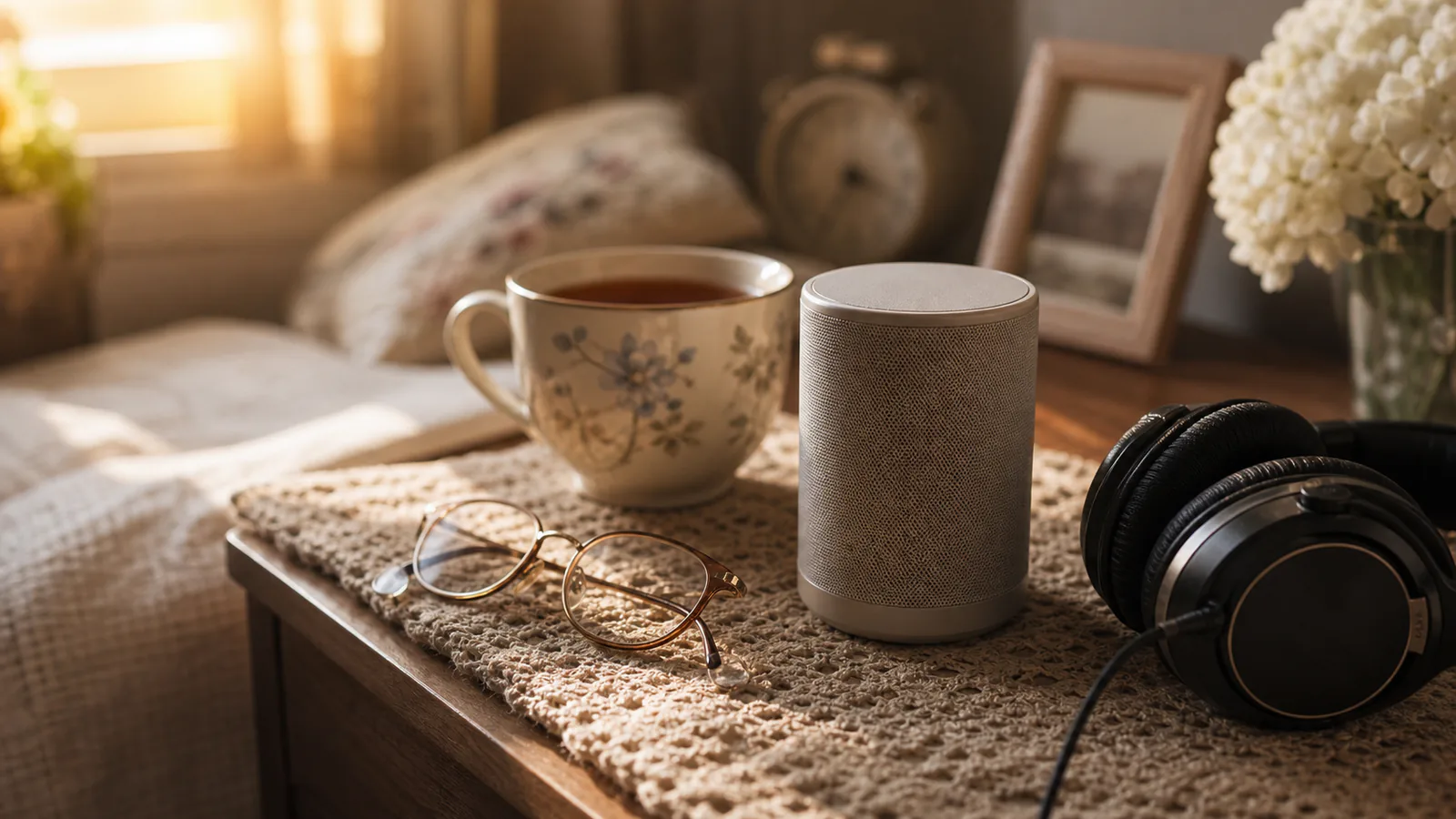
Slow, clear and short. Aim for 60 to 80 BPM, 2 to 3 minutes, one lead voice mixed clearly above the instruments, and no dense production that turns lyrics into mush on a small speaker.
Three practical rules:
- Clarity over production. Fewer layers, one voice forward. Hearing loss punishes crowded mixes long before it punishes volume.
- Familiarity over trend. Match the era and genre they actually listened to — big band, bolero, classic country, sertanejo, gospel, whatever was playing when they were 25. A familiar instrument does more for recognition than any clever arrangement.
- Names over adjectives. "Kind and loving" is filler. "You kept the porch light on until we were home" is the song.
One thing to be upfront about: the lyrics and the recording are generated from a written brief. A person writes the brief and a person checks the result before delivery, but the performance itself is produced. Say so if you are asked — most families care far more that the details are right. For listeners whose memory is affected, the choice of era and arrangement carries even more weight than it does here.
Which playback setup is easiest for them?
The one with the fewest steps between them and the sound. Count the physical actions required to press play — if it is more than two, they will wait for a visitor instead, and the gift becomes something they need permission to use.
| Playback setup | Steps to press play | Needs internet | Typical one-time cost |
|---|---|---|---|
| USB stick in a player they already own | 1 | No | $0 |
| Preloaded MP3 player with headphones | 2 | No | $25–$40 |
| Smart speaker with a spoken command | 1 spoken | Yes | $30–$50 |
| CD burned and labeled by hand | 2 | No | $1–$3 per disc |
| Link sent by message on a phone | 4 | Yes | $0 |
The link is the worst option on this list and the one most people default to. Send the file, but also deliver it on something physical — a labeled USB stick or a loaded player left on the side table outperforms any download, because it works on the days nobody visits.
What should you say when you order it?
Write six lines and stop. The brief is the whole job, and the full brief checklist covers the general form — here is the version tuned for someone who is homebound.
For: [name], my [relationship], [age], at home since [year]. What they did: [job, craft or role they were known for, and how long]. Three specifics: [a place, an object, a habit — the sticky piano key, the porch light, the Tuesday phone call]. Present tense: [one thing they still do for someone else]. Sound: [era or genre they listened to at 25], slow, one clear voice. Leave out: [illness, losses, or anything the family does not discuss].
That last line matters more here than anywhere else. Do not put their diagnosis, their decline or their late spouse's death in the song unless the family has told you it is welcome — a track that turns into an inventory of what is gone will get played once.
Frequently asked questions
How long should a song for a homebound senior be?
Two to three minutes. Shorter than a standard radio track, because attention and hearing both work against a long one, and because a short song survives daily repetition where a five-minute one starts to feel like a commitment. Keep it to two short sections and one chorus, and put the single most specific detail in the first thirty seconds, before anything competes for their attention.
Can family members' voices or messages be included?
Recorded voice messages are a separate layer you add yourself, and it is worth doing. A common approach is to keep the song as one file and put a 20-second recorded greeting from each grandchild on the same USB stick as separate tracks. That way the song stays playable on repeat without a spoken intro in front of it every single time, and the messages stay findable.
Is the song written by a person or generated?
Generated, from a human brief. You write the details, a person reviews the draft and the delivered file, and the lyrics and vocal performance themselves are produced. This is worth stating plainly to the family beforehand, because a surprise is worse than a disclosure — and in practice the specifics in your brief, not the production method, are what makes someone recognize themselves in it.
What if they have hearing loss?
Prioritize a clean mix over volume. Ask for one lead voice well above the instruments, avoid heavy percussion and wide stereo effects, and provide the lyrics printed in large type so they can read along the first few times. A small dedicated speaker at arm's length beats a phone speaker or a distant TV soundbar, and headphones beat both if they will tolerate wearing them.
How do I send it if I live far away?
Mail the physical version and let someone local set it up. A labeled USB stick, a loaded MP3 player, or a CD in an envelope arrives without needing anyone technical on the other end. If a home aide or a neighbor visits regularly, ask them to plug it in once and leave it ready — the Family Caregiver Alliance keeps practical guidance for families at a distance.
Related reading: songs that help with memory recall, recognition for the person doing the daily care, and using music through a long recovery.
Ready to make one? Start the song here and spend ten minutes on the details — the specifics you already know are the entire gift.
About the Author
HosannaSong Team
The HosannaSong team helps people turn meaningful stories into custom songs. We write about personalized music, songwriting, and the craft of giving a track that lasts.
View ProfilePersonalized Music for Dementia Patients: Songs That Reach Back
Custom Meditation Song: Turn Your Own Words Into Calm Audio
Related Articles
Personalized Music for Dementia Patients: Songs That Reach Back
Read Article
Custom Song for a Caregiver: Recognition for Invisible Work
Read Article
Custom Healing Song: Using Music as a Tool for Recovery
Read ArticleTurn this story into a custom song.
Answer a short brief, choose the style, and get a personalized song made to move the person you love. Start while the memories are still fresh.
Create My Song Now