50th Anniversary Gift for Parents: A Song From Their Own Story

Editorial Team

Fifty years together deserves more than a photo album. How to build a golden anniversary song from your parents' history and play it at the party.
Create a custom song for someone special
Share the story, pick the style, and turn your memories into a one-of-a-kind song.
Quick answer: A 50th anniversary gift song is an original track built from a brief the family writes: how the couple met, where they lived, what they got through. Most run 2 to 4 minutes and arrive in 24 hours to 10 days. Families play it once at the anniversary dinner, then share the file.
Fifty years is 18,250 days and roughly 2,600 weekends of choosing the same person. The problem for the children is that a couple together that long already owns everything, has downsized twice, and does not need another engraved plate. The gift that still has room in the house is the one that takes up no space at all.
Why is a song the right 50th anniversary gift?
Because it is the only item on your list that cannot be bought for anybody else. Every other option — the watch, the frame, the crystal bowl — exists in a warehouse in ten thousand identical copies, and the National Retail Federation tracks how much households spend each year on exactly that kind of interchangeable purchase.
A song built from their history does something a purchased object cannot: it says we were paying attention. It names the truck, the street, the job, the year money was tight. That is the difference between honoring a marriage and marking a date. If you want the full picture of how these tracks get made, start with the complete guide to personalized tracks.
How do you fit 50 years into one song?
You don't. You pick four moments and let them stand for the rest — a song is a documentary, not an archive, and four minutes holds roughly four scenes.
Most 50-year marriages break down into the same arc:
- The spark. Meeting in the 1970s, the awkward first dates, the decision to build something with a person nobody else had picked out for them.
- The building years. Small kids, long shifts, a second job, a car that barely started. This is where most of the specific detail lives.
- The hard chapters. Every long marriage has weathered something — illness, a job lost, a year the family still doesn't discuss in detail. Naming that the storm came and the house held is more powerful than pretending it never rained.
- The harvest. The table today: the grandchildren, the people who exist because those two stayed.
Write those four down before you write anything else. The verses almost assemble themselves.
Why does a song beat another object?
Because it takes up zero shelf space and travels for free. Most couples in their seventies and eighties are trying to own less, not more, which quietly disqualifies about ninety percent of the gift aisle.
- Nothing to store. A track fills the room and then lives on a phone. Nobody has to find a place for it.
- It goes everywhere. Unlike a photo album that sits on one sibling's coffee table, an audio file reaches the cousins in California, the aunt in England and the grandchild in a dorm room the same afternoon.
- It has a reveal. A gift you can open in front of forty people, once, with everyone quiet, is a different category of gift.
The same logic applies at smaller milestones, but it applies hardest at fifty, because that is the year the family runs out of ideas entirely.
How do you play it at the party?
At the end of dinner, standing, with one sentence of introduction and no speech. The shorter your setup, the harder the song lands.
Picture it. The plates are cleared. You stand and say: "Mom, Dad — we wanted to give you something you can't hold, only hear." You press play. An acoustic guitar comes in, and then the song is about the blue truck Dad drove in 1974, the tiny apartment on Elm Street, the way Mom was up at five with the radio on. Nobody in that room is checking a phone.
Two pairings that work, if you want more than audio:
- A photo montage. Use the track as the bed for a slideshow of the last fifty years. The images do the visual work; the song keeps the timing.
- A framed lyric sheet. Print the words, frame them, hand them over after the track ends. It is the object that ends up on a wall, and it makes the song visible on days nobody feels like playing it.
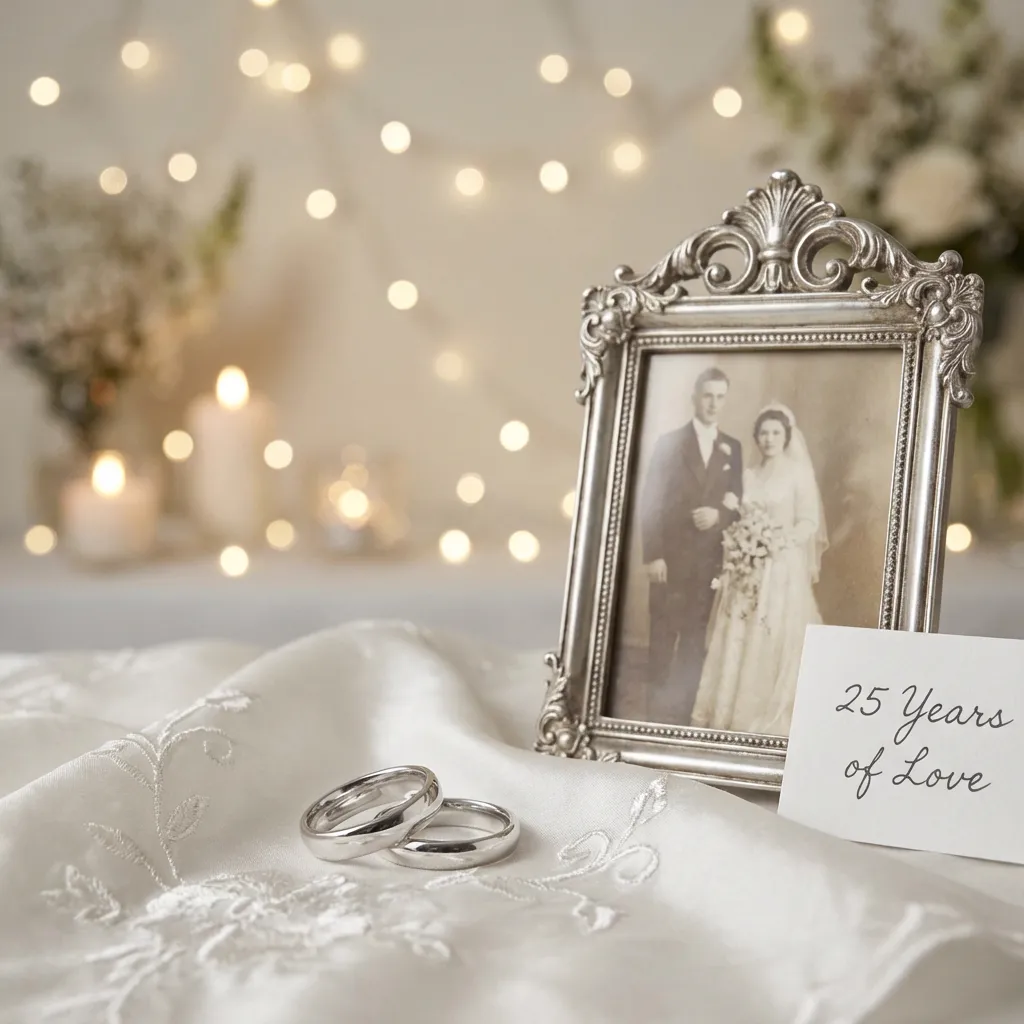
Will the grandchildren still hear it?
Yes, if the lyrics name things a stranger would need explained. A song that says "they loved each other very much" dies with the party; a song that says the street, the year and the job survives it.
This is not sentiment, it is how family history actually gets carried. The Songs of America collection at the Library of Congress exists because songs turned out to be one of the most durable ways a generation stores what happened to it — more durable than most documents, because people replay them voluntarily. A track about your parents works the same way on a smaller scale. In thirty years, a great-grandchild who never heard your father's voice will still know he drove nights, that the house on Elm Street was small, and that the two of them stayed.
How much does a 50th anniversary song cost?
Between $30 and $2,000+, and golden anniversary tracks usually justify the middle tier, because you want enough length for a second verse and enough revision rounds to fix a misspelled name. Price tracks length, revisions and speed.
| Option | Price | Length and revisions | Turnaround |
|---|---|---|---|
| Entry tier | $30–$80 | 2–3 min, 1 revision | Same day to 72 h |
| Mid tier | $80–$300 | 4–5 min, 2–3 revisions | 3–10 days |
| Premium tier | $300–$2,000+ | Multiple drafts, full master | 1–3 weeks |
| Gift voucher | Tier you choose | Family writes the brief | Emailed in minutes |
If four siblings are splitting the cost, order one mid-tier track rather than four cheap ones — the extra revision round is what protects you from a name pronounced wrong in front of the whole family. The full breakdown is in our guide to what a personalized track costs. If nobody can agree on the details in time, a voucher the family redeems later hands over the brief instead of the finished song.
How should the song be structured?
Four blocks, in chronological order, ending on the people in the room. This is the shape that works for a milestone this large, and it maps cleanly onto the four moments you already wrote down.
- Verse 1 — the beginning. Young, broke, certain. The wedding day, the year, the town.
- Verse 2 — the middle. The work, the kids, the thing that held when it would have been easier to stop.
- Chorus — the theme. One phrase the room can hum by the second pass: "Fifty Years of Us," "Still Here," "The House You Built."
- Bridge — forward. A direct line to the family that follows. This is the part the grandchildren remember.
For the arrangement, match the decade they were young rather than the one you were. A couple who married in the mid-1970s came up on country, soul, bolero or sertanejo depending on where they lived, and a track in their own idiom sounds like it belongs to them. Around 3 to 4 minutes, mid-tempo, one voice, nothing loud enough to bury the words.
What should you put in the brief?
Eight answers cover a 50-year marriage. You write the brief; the track is generated from it and reviewed by a person before it reaches you.
- Both full names, plus what they call each other and what the grandchildren call them.
- The wedding date and the town. Year, rented hall, backyard, courthouse — whichever it actually was.
- How they met. In one sentence, with the detail that makes it theirs and not generic.
- What they did for work, both of them. Naming concrete acts rather than qualities is the same mechanic behind the written gratitude exercises collected by the Greater Good Science Center at UC Berkeley, and it lands deeper than a compliment.
- One hard chapter, and how much of it you want said out loud. You control this line.
- Two objects or places. The truck, the kitchen, the beach house, the recipe card, the road they drove every Sunday.
- The names to include, spelled and marked for pronunciation — and which ones matter most, because nine names in one verse become a roll call.
- Their genre, taken from their record shelf and not from your streaming history.
The long version of this checklist lives in our step-by-step briefing playbook.
Frequently asked questions
Can we name the children and grandchildren?
Yes. Send the full list with the spelling and pronunciation you want sung, and mark which names carry the most weight. The bridge is the usual home for them, since that section is already pointed at the next generation. Be realistic about volume: two or three names in the verses with the rest covered as a group in the last chorus sounds like a song, while eleven names in a row sounds like an attendance sheet.
Is this better for a 25th or a 50th anniversary?
Both work, and the difference is what the song is about. A 25th sits mid-story — the kids are still at home, the arc is unfinished, and the track tends to look forward. A 50th looks back across a completed span and can name outcomes the couple could not have predicted. Same format, different centre of gravity: at twenty-five you write about what they are building, at fifty about what they built.
Can we keep it a surprise until the party?
Yes, and most families do. Order in one person's name, use an email address the couple never checks, and keep the lyric draft off any group chat they belong to. Give yourself a buffer of at least a week before the date so a revision round fits comfortably. If the party is in three days, choose the fastest tier and accept a shorter track rather than gambling on the delivery window.
Who owns the song after it is delivered?
You do, under the terms you buy it on, which is why the ownership question matters more here than with a physical gift. The U.S. Copyright Office explains what copyright covers and what it does not. In practice, families want to know whether they can play it at a party, post it to a family group and use it under a slideshow. Read the licence you are buying before you assume it covers public posting.
How long should the song be?
Three to four minutes is the range that works for a party. Under two minutes there is no room for the middle years, and past five the room starts shifting in its chairs — even a good track loses a dinner table after the fourth verse. Four minutes fits two verses, a chorus repeated three times and a bridge, which is exactly the structure a 50-year marriage needs.
Related reading: a track for twenty-five years together covers the silver milestone, marking any anniversary with a personal track handles the years in between, and how a first dance track gets briefed is where the whole thing started.
Ready when you are: start their anniversary song here and tell us the details only your family would think to mention.
About the Author
HosannaSong Team
The HosannaSong team helps people turn meaningful stories into custom songs. We write about personalized music, songwriting, and the craft of giving a track that lasts.
View Profile25th Anniversary Song: A Personalized Track for Silver Years
Custom Proposal Song: The Right Track for the Moment You Ask
Related Articles
25th Anniversary Song: A Personalized Track for Silver Years
Read Article
Custom Anniversary Song: Mark Your Years With a Personal Track
Read Article
Custom Wedding Song: A Personalized First Dance or Processional
Read ArticleTurn this story into a custom song.
Answer a short brief, choose the style, and get a personalized song made to move the person you love. Start while the memories are still fresh.
Create My Song Now