Custom Meditation Song: Turn Your Own Words Into Calm Audio

Editorial Team
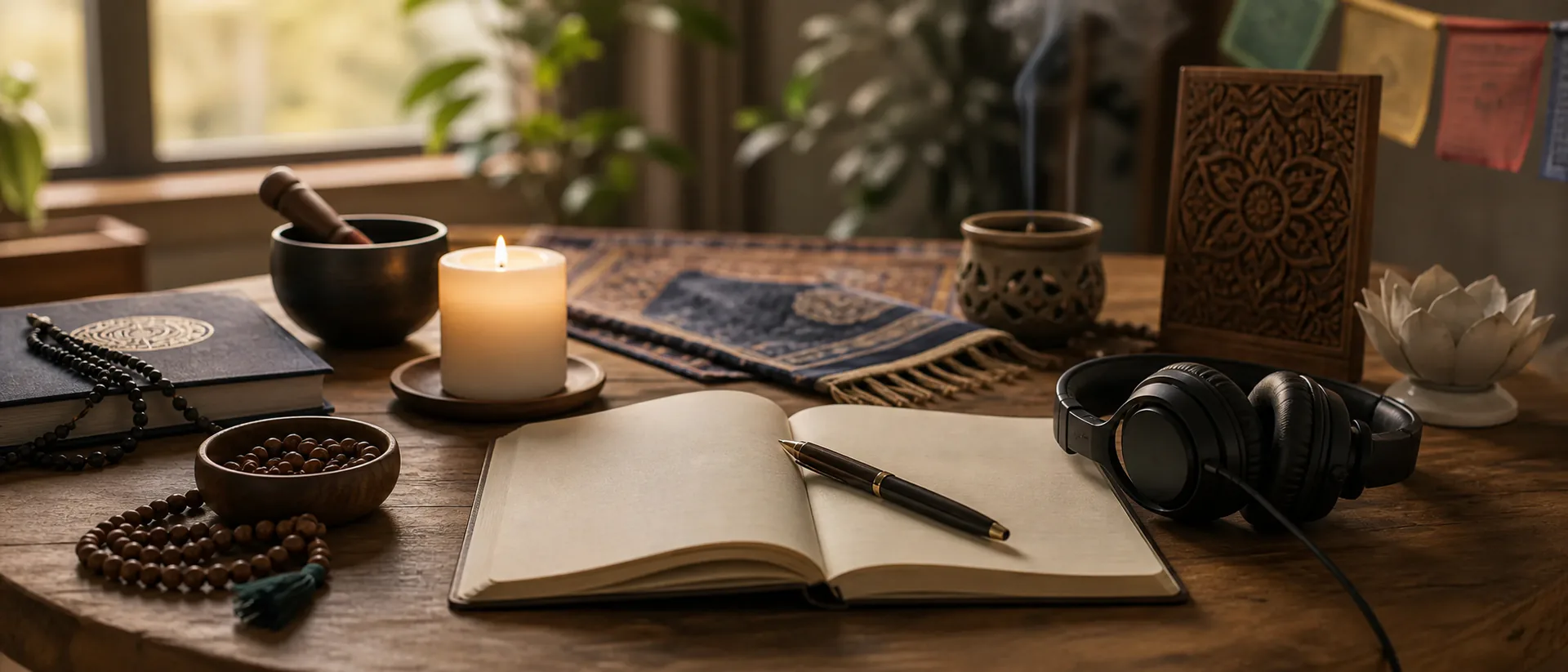
A meditation track built from your own words and pace. How to choose the tempo, the voice and the length, and how to use it in a daily practice.
Create a custom song for someone special
Share the story, pick the style, and turn your memories into a one-of-a-kind song.
Quick answer: A custom meditation song is an audio track built from words you supply — an intention, a phrase, a name — set to a slow arrangement, usually 60 to 80 BPM and 3 to 5 minutes long. People use it as a daily anchor: the same track before sleep, at the start of a focus block, or during a breathing session.
A custom track is a personal audio tool, not treatment for anxiety, insomnia or any medical condition — if you or someone close to you is struggling, call or text 988 (Suicide & Crisis Lifeline).
You already know what you want the track to say. The problem is that every meditation app hands you the same anonymous piano loop, with the same anonymous voice, saying nothing that belongs to you. A custom meditation song fixes that half of the equation: the words are yours, the pace is set to your breath, and the track sounds the same every single time you press play.
This guide covers what the format actually is, how it differs from an ordinary custom song, what tempo and length to ask for, and how to write a brief that produces something you'll still be using in six months.
What is a custom meditation song?
A custom meditation song is a finished audio track — original lyrics, a vocal, a full arrangement — built around one intention you write down in advance. It shares the format of any personalized song, but the purpose is different: a birthday song is made to be heard once at a party, while a meditation track is made to be repeated.
That repetition is the whole point. The National Center for Complementary and Integrative Health notes in its overview of music and health that listening is studied for stress and mood, not as a cure. Your track isn't doing anything magical. It's giving your attention one fixed place to land, so you don't have to negotiate with a playlist at 11pm.
Think of it as the audio equivalent of a worn path. The first walk is slow. By the twentieth, your body knows where it's going.
How is it different from a regular song?
Three things separate a meditation track from a normal custom song: the tempo, the repetition and the single intention behind it.
Tempo and breath. Meditation tracks sit in the 60–80 BPM range — slow enough that your breathing settles into the rhythm instead of chasing it. That isn't a stylistic preference. Slower tempos pull the pace of your breath down with them, which is why slow music is the default in wind-down routines everywhere.
Repetition. A meditation track uses repetition on purpose. The chorus returns, the central line comes back, sometimes a phrase loops through the final thirty seconds. It isn't filler — it's the architecture. Repetition is how a song stops being something you listen to and starts being something that runs underneath you.
One intention. A regular custom song captures a relationship. A meditation track carries a single line of intent: steadiness before a hard conversation, quiet at the end of a shift, focus for the first hour of the workday. The whole brief is built around that one sentence.
Who orders a custom meditation track?
Most of the requests we see come from six situations, and none of them are exotic:
- You want a wind-down that isn't a screen. The last twenty minutes of the day, same track, lights low.
- You're managing anxiety and want something to hold. A track to start when the spiral starts, before the night gets away from you.
- You need a focus cue for deep work. One track that means "the next 50 minutes are for this."
- You run a group. A yoga teacher, a school counsellor, a team lead who opens Monday meetings with two minutes of quiet.
- You're rebuilding a routine after a hard season. A move, a breakup, a job loss, a recovery — a fixed audio marker helps a new routine stick.
- You want to give one. A parent who can't sleep, a friend in a rough stretch, a colleague leaving the team.
What makes a meditation track work?
After making a lot of these, the pattern is consistent. The tracks people keep using have five things in common.
1. A clear intention. One sentence in plain language. "For the ten minutes before I open my laptop." "For my mother's afternoons, when the house is empty." Everything else is built on that line.
2. One specific anchor. A name, a place, a time of day, an object. The lyrics don't need to be a documentary, but one concrete detail gives the track something to grip. "The kitchen window at six" beats "a peaceful place" every time.
3. A contemplative tempo. 60–80 BPM. Slower than pop, slower than most background music. Slow enough that the track doesn't push you anywhere — it walks next to you.
4. A repeating central phrase. One short line that comes back. "You're allowed to stop." "Slow hands, slow breath." "This part is done." Short enough to remember after a single listen, which is what makes it usable later without the audio.
5. A settled ending. The last 15 seconds matter more than people expect — they're what you're left holding. A track that ends unresolved will quietly stop getting played.

What tempo and length work best?
Match the numbers to the moment you'll actually use it in, not to how the track sounds on first listen. A 5-minute wind-down track is a bad focus cue, and a 3-minute focus cue is a bad sleep track.
| Use case | Tempo | Length | How it should end |
|---|---|---|---|
| Morning reset | 70–80 BPM | 3 min | Clean stop, no fade |
| Focus block start | 65–75 BPM | 3–4 min | Instrumental tail |
| Wind-down before sleep | 55–65 BPM | 5 min | Long fade to silence |
| Grounding during a spike | 60–70 BPM | 3 min | Repeated line, twice |
| Group or class opening | 65–75 BPM | 4 min | Clean stop, no fade |
| Walking practice | 75–85 BPM | 5 min | Steady, no fade |
The sleep row is the one people most often get wrong. Guidance from the Sleep Foundation on music and sleep points to slow, low-stimulation audio and a consistent routine rather than volume or novelty, and the NHS advice on insomnia puts the same weight on doing the same thing at the same hour. A track that fades out beats one that ends on a bright chord.
Which sound style fits your practice?
Pick the arrangement by how much attention you can spare. The busier the track, the more of you it takes.
- Acoustic — voice, guitar, maybe piano. The default. Intimate, low-stimulation, works in almost any room.
- Solo piano with a soft vocal. For sleep and for late evenings. The least demanding option on this list.
- Ambient pads and electronic texture. For focus blocks, where you want presence without a story pulling your attention.
- Strings or small chamber arrangement. For a track that will be played in front of other people — a class, a memorial, a group session.
- Lullaby. For children, and for adults who use the track strictly at bedtime.
- Sparse folk with a spoken cadence. When the words matter more than the melody, which is usually the case when the lyric is a line you want to remember.
If you can't decide, choose acoustic. It's the one that ages best.
How do people use it day to day?
The honest answer: they use it as a scheduling tool. The track becomes the signal that a certain part of the day has started or ended, and the routine around it does most of the work.
- On a speaker at a fixed hour, so the household knows the day is winding down.
- Through headphones on a commute, as the buffer between work and home.
- At the start of a class or team session, three minutes, then straight into the agenda.
- Next to the bed at low volume, on repeat, for someone who wakes at 3am.
- Sent to one person, quietly, with no explanation attached.
People who use a track daily usually end up wanting a second and a third — one for mornings, one for sleep, one for the gym. If that's the direction you're heading, a monthly song membership is cheaper than ordering them one at a time.
What should you say in the brief?
You don't have to write poetry. You have to be specific. Ten to fifteen minutes here is the difference between a track you keep and a track you play twice.
- Who is it for? Yourself, or a name and your relationship to them.
- When exactly will it be played? "Before sleep." "First thing at my desk." "In my Tuesday class." This drives tempo and length.
- What is the intention? One sentence. Steady, focus, rest, release, gratitude, courage.
- The line you want repeated. Six words or fewer, in your own phrasing.
- Two concrete details. A place, an hour, an object, a habit. These are what stop the lyrics from sounding generic.
- Voice preference. Male, female, soft, warm, low. Say if you want the words nearly whispered.
- What must not appear. No mention of the illness by name, no mention of the ex, no reference to work, no upbeat ending — whatever the case may be.
- A reference track. Anything with the feel you're after. One link is worth a paragraph of description.
The brief is the part only you can do. Everything after it is production.
Frequently asked questions
Who actually writes and performs the track?
The lyrics and the recording are produced from the brief you fill in, and a person on our team reads the brief and reviews the lyric draft before anything is produced. There is no session vocalist and no studio band. You approve the words at the draft stage, which is where to flag a name spelling, a phrase that doesn't sit right, or a tempo that feels too fast.
Do I need to know anything about music?
No. You need to know when you'll listen and what you want the track to say. Tempo, key and arrangement are chosen from your answers about the moment of use — "before sleep" produces a very different track than "before a presentation." If you supply a reference song you already like, that single link does more than any technical vocabulary would.
How much does a custom meditation track cost?
Most meditation tracks sit in the mid-tier range, roughly $80–$300, because the lyric work is more delicate and the arrangement is deliberately sparse, which leaves nothing to hide behind. Pricing follows the same tiers as any other order, broken down in our guide to what a custom track costs. Length and extra versions are the two variables that move the number most.
Can I play it in a class or at an event?
Yes. Personal-use rights cover private settings — a yoga class, a memorial, a team meeting, a classroom. What they don't cover is commercial distribution, monetized video or paid streaming placement, which needs a different licence. The details are laid out in our guide to usage rights, and it's worth a two-minute read before you upload anything publicly.
Is this the same as music therapy?
No, and it's worth being clear about it. Music therapy is a clinical practice delivered by credentialled professionals, as defined by the American Music Therapy Association, with assessment and treatment goals. A custom track is a personal audio object you own and replay. It can support a routine you're already building; it isn't care, and it shouldn't replace any.
How long should the track be?
Three to five minutes for most uses. Long enough to settle into, short enough that you'll actually finish it on a busy day. Go to five minutes for sleep and walking practice, where you want the track to outlast the moment of transition. Stay at three for a focus cue, where the point is to start working, not to keep listening.
Related reading
For the routine itself, start with our daily listening guide. If the reason you're here is a racing mind at night, read the track built for anxious moments next. And if you want the words to do more of the work than the melody, the affirmation track format is the closer fit.
Ready to make yours? Start your custom meditation track — the questions take about ten minutes, and you'll see the lyrics before anything is produced.
About the Author
HosannaSong Team
The HosannaSong team helps people turn meaningful stories into custom songs. We write about personalized music, songwriting, and the craft of giving a track that lasts.
View ProfileMusic Gift for Homebound Seniors: A Track Made Just for Them
Custom Song for Anxiety: Music for Panic, Sleep and Quiet
Related Articles


Turn this story into a custom song.
Answer a short brief, choose the style, and get a personalized song made to move the person you love. Start while the memories are still fresh.
Create My Song Now