Custom Classical Song: How to Get a Personalized Piece Composed

Editorial Team
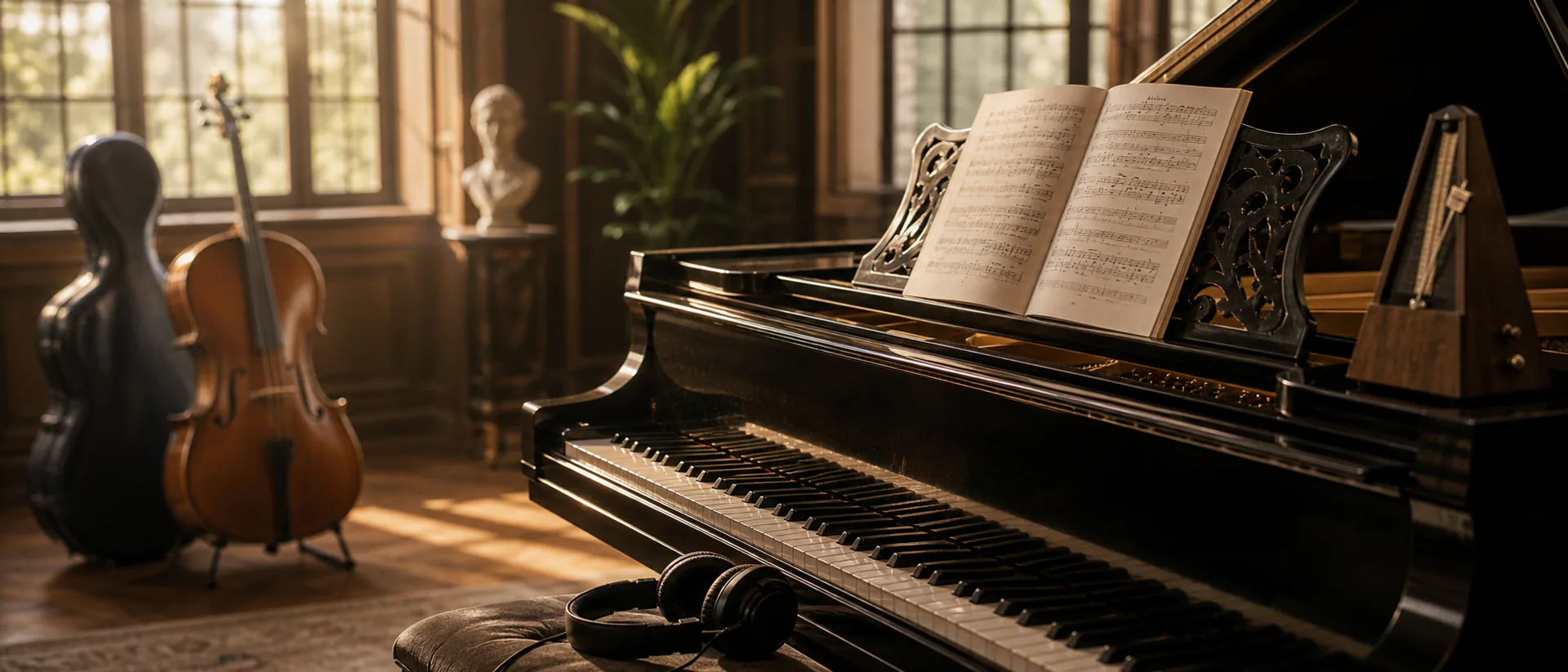
Piano, strings or full orchestra, with or without a vocal. How to brief a classical commission and where it works, from weddings to memorials.
Create a custom song for someone special
Share the story, pick the style, and turn your memories into a one-of-a-kind song.
Quick answer: A custom classical song is an original orchestral or piano piece created from a written brief for one specific occasion. Most run 2 to 6 minutes at 50 to 120 BPM, with or without vocals. A common use is a wedding processional timed to fill the walk down the aisle.
Every other genre on the menu is dated by the year it was made. A pop track from 2011 announces 2011. A string quartet does not announce anything — it just plays. That is the whole argument for classical: it is the format least likely to embarrass you in a decade. This is one branch of the complete guide to commissioning a song, and it is the branch people reach for when the moment has to outlive the trend.
When is a classical piece the right choice?
Classical fits moments that already have a shape — a ceremony, a procession, a send-off, a film sequence. It is the wrong call when you want people singing along, and the right call when you want them quiet.
The strongest fits:
- Wedding processionals — a piece written to the length of the aisle, not cut to fit it
- Memorials and life celebrations — strings carry weight that a lyric sometimes gets in the way of
- Vow renewals at a 25th or 50th anniversary
- Retirement send-offs for a manager, teacher, or coach who spent decades on the same room
- Naming celebrations and first-birthday films, in a music-box or lullaby register
- Proposals that are being filmed, where the audio has to work as a score
- Tributes to musicians, dancers, and artists who will actually hear the arrangement
- School, company, or team anniversaries — an opening, a centenary, a final season
Ceremonial music is not a European invention, and the Library of Congress collection of songs of America is a good reminder of how many traditions built their own version of the processional. If your family already has one, say so in the brief.
Which classical sub-style fits your moment?
Pick one sub-style before anything else, because it decides instrument count, tempo range, and length more than the occasion does. Solo piano is the safest entry point; full orchestral is the one that eats budget and time.
| Sub-style | Core parts | Typical BPM | Typical length |
|---|---|---|---|
| Solo piano | 1 piano | 55–75 | 2:00–3:30 |
| Piano + strings | piano + 4–8 string parts | 60–85 | 2:30–4:00 |
| String quartet | 4 parts | 65–95 | 2:00–3:30 |
| Choral | 4–16 voice parts | 50–80 | 2:30–4:30 |
| Chanson / art song | 1 voice + 1–3 instruments | 70–100 | 2:30–3:30 |
| Neo-classical / minimalist | piano + strings or pads | 55–90 | 3:00–6:00 |
| Full orchestral | 30+ parts | 50–120 | 3:00–6:00 |
Reference points that translate well into a brief: Ludovico Einaudi and Nils Frahm for solo piano, Yiruma and Max Richter for piano and strings, Ólafur Arnalds for neo-classical, Joe Hisaishi and Hans Zimmer for the orchestral end. Name two, not six. If you cannot name any, send a link to a piece you already replay.
What tempo and length should it run?
Most classical commissions land between 50 and 120 BPM and between 2:00 and 6:00, with ceremonial pieces at the long end because they have to cover a real block of time. Structure is usually through-composed — the piece develops instead of returning to a chorus.
That last point is the practical difference from every other genre. Pop lives on repetition and a hook you get inside twenty seconds; if that is what your moment needs, a hook-driven arrangement will serve you better. Classical earns its emotion by taking longer, which only works if the room is willing to wait.
Two numbers worth measuring before you order: how many seconds the walk, the slideshow, or the speech actually takes, and how many of those seconds need music underneath. Time it on your phone once. A piece written to 3:20 and used over a 4:40 sequence will loop awkwardly, and nobody notices the problem until the day itself.
Where do people actually use these pieces?
The most common uses are ceremonial and cinematic: a processional, a memorial service, a milestone video. The second cluster is institutional — openings, anniversaries, retirements — where the piece functions as a signature the group keeps.
Concrete examples people order:
- A processional built around how the couple met, played once, live in the room
- A memorial piece for a service, then kept as the family's recording
- A 50th-anniversary vow renewal, scored for quartet
- A background score for a milestone family video or year-in-review film
- A quiet track for a naming celebration or a first-birthday montage
- A company centenary or a school's final-season assembly
- A retirement tribute for a mentor, played while the slideshow runs
If the moment is warmer and more conversational than any of these, classical may be over-dressed for it. A gift for a colleague at leaving drinks, for instance, usually plays better as something looser and warmer.
What does a custom classical piece cost?
Classical sits at the higher end of the range, typically $200 to $1,000+, because more instrument parts mean more arrangement work and more revision passes. Longer, denser pieces also take more calendar time than a three-minute pop track.
The cost drivers are simple and worth knowing before you brief: part count, total length, whether there is a vocal, and whether you need the piece to hit an exact runtime. A 2:30 solo piano piece and a 5:30 orchestral one are not the same job. The full breakdown by tier is in what a commissioned track costs, and you can browse the full package lineup to see what each level includes before you write anything.
One note on how the work is made: the audio is produced from the brief you write, and a person reviews the result before it is delivered. The brief and the review are human. The performance is not, and no classical commission here involves booking a room full of players.
What should you say in the brief?
Name the moment, the emotional register, the exact length, and the instrumentation — in that order. Then give two reference pieces as direction, not as something to copy.
The six things worth writing down:
- The moment. A processional and a memorial recessional have almost nothing in common technically.
- The emotional register. Awe, mourning, triumph, quiet wonder, gratitude, resolve — pick one word, not four.
- The length. If it has to fill a block, give the number in minutes and seconds.
- The instrumentation. Solo piano, quartet, choral, orchestra.
- Vocal or instrumental. Many classical pieces are stronger without a voice.
- A reference piece. One composer or one track that anchors the feel.
Restraint is the whole skill here. The brief should say what the recipient actually listens to; it should not try to specify every chord change and swell. Give the emotional target first, the references second, and then leave room.
Name the lines the piece should not cross, too. If the family dislikes anything that sounds like a film trailer, say that. If the arrangement should feel modern but not ambient-wallpaper, say that. If a choral section is welcome in the middle but not at the opening, say that. Boundaries make the result sharper, not narrower — the same principle laid out in how to write a song brief.
Before you order, gather five ingredients: the name, the occasion, one concrete detail only you would know, the feeling the final thirty seconds should leave behind, and one piece that points in the right direction. That is enough.
Frequently asked questions
Will it sound like an orchestral recording?
The audio is produced from your written brief, then checked by a person before delivery, and it is mixed to sound like a studio orchestral or piano recording rather than a demo. Density is the honest limit: solo piano and small ensembles hold up best, while very large orchestral arrangements are where a trained ear is most likely to notice the difference.
Can I get sheet music with the piece?
Sheet music is available as an option on premium orders, and you have to ask for it in the brief — it is not produced by default. Say so up front rather than after delivery, because the notation is prepared alongside the piece. If you plan to hand the score to musicians later, mention that too, since it affects how the parts are laid out.
Can musicians perform it live at my event?
You would arrange the performance yourself; what you receive is the composition and a recorded version, plus notation if you ordered it. Be aware that performing a work in public can involve separate rights from owning a copy of it, and the U.S. Copyright Office explainer on what copyright covers is the clearest starting point on which rights are which.
Can the piece have words?
Yes. Choral and art-song formats are both on the menu, and a single voice over piano is one of the most requested versions. Bear in mind that words change the maths: a vocal line needs a clear syllable count and a slower tempo to stay intelligible, so a sung piece usually carries fewer ideas than an instrumental one of the same length. Keep the lyric short.
Can it be in another language?
Yes — Latin, French, Italian, German and others all work in the classical vocal formats, and the phonetics of those languages were shaped by centuries of this exact repertoire. The archive of world traditions at Smithsonian Folkways is a useful place to hear how differently a language sits on a melody before you commit to one.
What is the maximum length?
Six minutes is the practical cap, mainly for cost, though longer ceremonial pieces can be arranged if you explain what they need to cover. Above that length a through-composed piece needs real structural development, not just more bars, which is a bigger job. If your sequence runs longer, a 5:00 piece with a designed ending usually beats a stretched one.
Related reading: a warmer, improvised jazz arrangement covers the loose end of the spectrum, a modern pop arrangement instead covers the hook-driven end, and how ceremonial songs travel between cultures is worth a look before you settle on a form.
Ready to commission your piece?
Tell us the moment, the instrumentation, and the exact length you need, and start your classical commission from there.
About the Author
HosannaSong Team
The HosannaSong team helps people turn meaningful stories into custom songs. We write about personalized music, songwriting, and the craft of giving a track that lasts.
View ProfileCustom Blues Song: How to Get a Personalized Blues Track Made
Custom EDM Song: How to Get a Personalized Electronic Track Made
Related Articles

Turn this story into a custom song.
Answer a short brief, choose the style, and get a personalized song made to move the person you love. Start while the memories are still fresh.
Create My Song Now