Personalized Music for Dementia Patients: Songs That Reach Back

Editorial Team
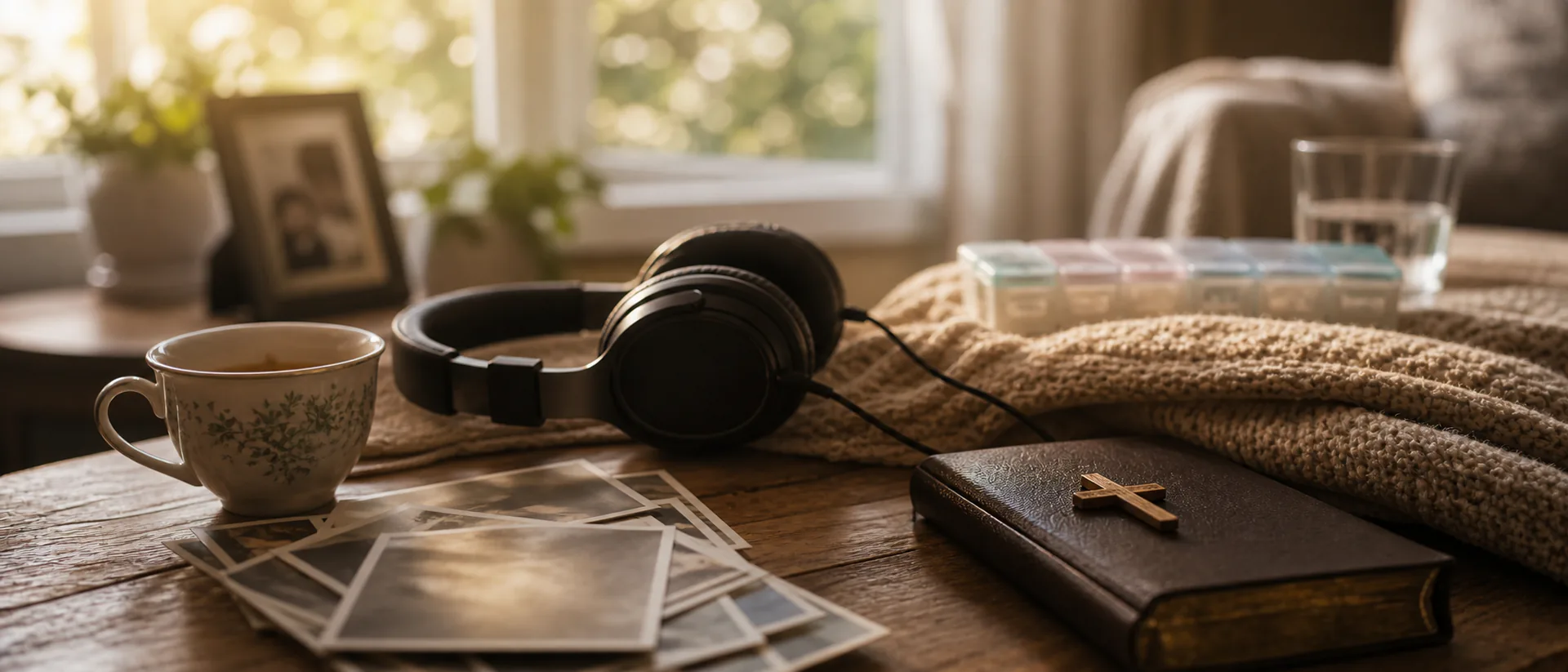
Familiar music can reach memory when conversation cannot. How to choose the era, the tempo and the names for a track built for someone with dementia.
Create a custom song for someone special
Share the story, pick the style, and turn your memories into a one-of-a-kind song.
Quick answer: Personalized music for dementia patients is a custom track built from one person's own names, dates and era of music, usually 60 to 90 BPM and 2 to 3 minutes long. Families use it as a fixed routine — the same track at the same hour each day, played on a small speaker.
A custom track is a personal audio tool, not treatment for dementia or any medical condition — if you or someone close to you is struggling, call or text 988 (Suicide & Crisis Lifeline).
You visit on a Tuesday and she asks the same question four times in an hour. She doesn't use your name anymore. Then the radio plays something from 1961 and her hand starts keeping time on the arm of the chair, and for a few minutes you are talking to someone who is there. That reaction is the reason families order a track built around one person instead of handing over another photo album.
Why does music outlast other memories?
Because musical memory and short-term memory live in different places. Dementia usually takes recent memory first — what happened this morning, the name of the person who just walked in — while long-practiced motor and musical patterns hold on much longer, which is why someone can lose the thread of a sentence and still keep tempo. The National Institute on Aging's overview of Alzheimer's describes that uneven decline: different abilities go at different rates.
This is not a small population. The World Health Organization dementia fact sheet counts more than 55 million people living with dementia worldwide, with roughly 10 million new cases a year. Most of them are cared for at home, by family, with a radio in the room.
None of that means a song fixes anything. It means music is one of the few doors still standing, and a personalized track is a way of knocking on it with the right name.
What does a personalized song actually do?
It gives a familiar structure a set of familiar words. A generic oldies playlist supplies the era; a custom track supplies the era plus the grandchildren's names, the street they lived on for thirty years, the dog, the job, the nickname only that family uses. Recognition points arrive one after another instead of by accident.
Three things tend to happen, none of them guaranteed:
Recognition. Hearing your own name sung is different from hearing it spoken across a room. It arrives with a melody attached, and melody is the part that still gets through.
Predictability. Confusion is what drives most agitation. A track played at the same hour every day becomes one of the few events in the day that behaves exactly as expected. The Alzheimer's Association's guidance on art and music in daily care treats familiar music as a routine tool, not a treatment.
A way to be in the room. When conversation stops working, sitting through three minutes of a song together is still doing something together. That is worth more than it sounds.
If you have never commissioned anything like this, the mechanics are the same as any other order — our complete guide to custom tracks covers the brief, the draft and the file you end up with.
Which era of music should you choose?
Pick the music they were between roughly 15 and 25 years old for, not the music they listened to last. Those are the years when songs get bound to first jobs, first cars and first relationships, and they are the years that stay legible longest.
Do the arithmetic before you write anything. Someone born in 1938 was twenty in 1958: Sam Cooke, Patsy Cline, early Elvis, big-band standards still on the radio. Someone born in 1952 was twenty in 1972: Aretha Franklin, Creedence, Carole King, Roberta Flack. Someone born in 1960 gets Fleetwood Mac and Stevie Wonder. If the family is Brazilian, the same rule lands on Roberto Carlos or Elis Regina; a gospel or a country arrangement works the same way if that is what was on in the kitchen.
Ask the family two questions and stop there: what did they sing along to in the car, and what did they dance to at their wedding. Two reference artists in the brief are worth more than a paragraph of adjectives.
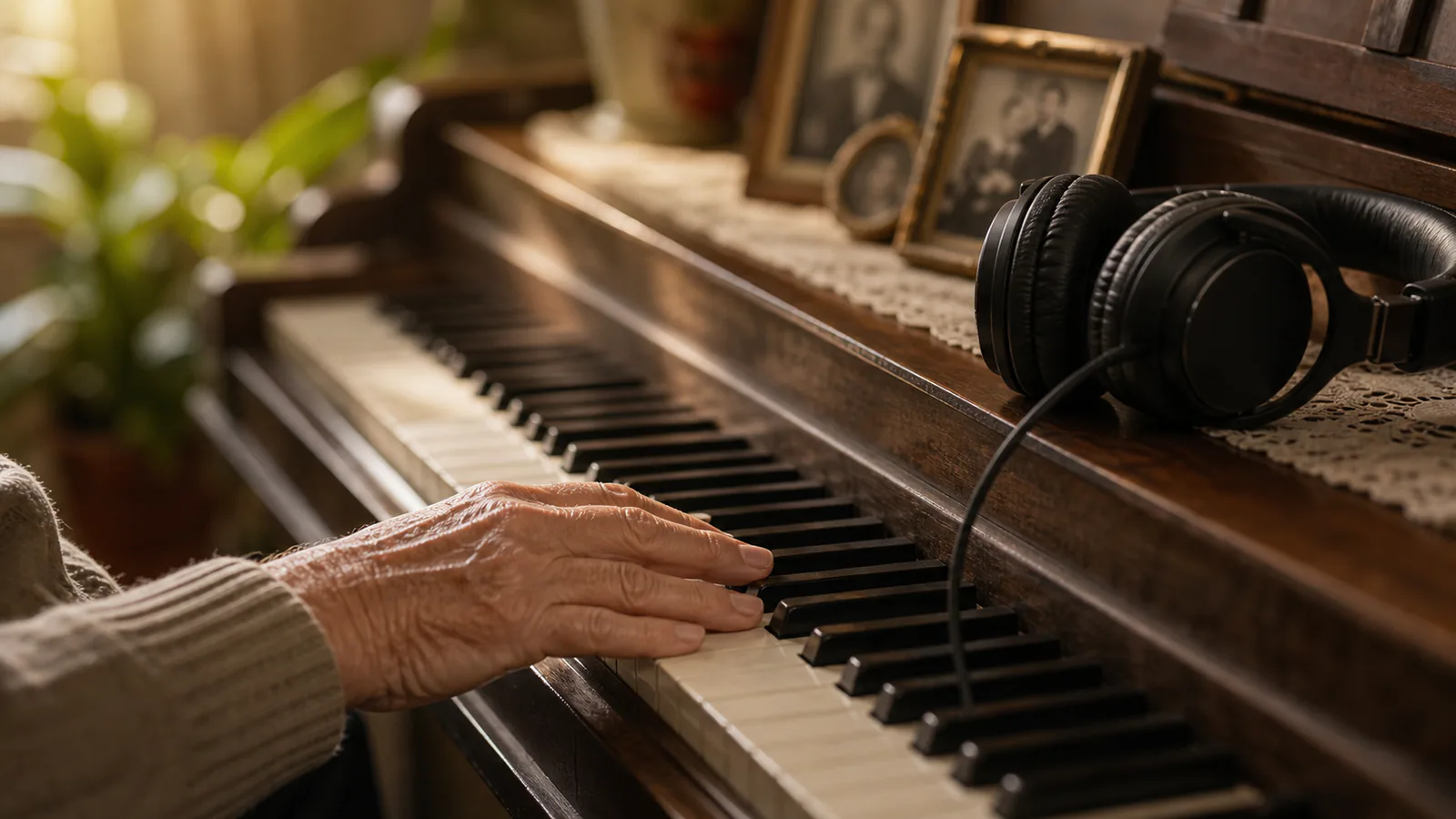
What tempo and length work best?
Slow and short. A track for someone with advanced memory loss should sit near a resting pulse and end before attention runs out, with a chorus that comes back often enough to be recognized by the third play.
| Element | What to ask for | Why the number matters |
|---|---|---|
| Tempo | 60–90 BPM | Near a resting pulse; faster arrangements tend to add restlessness |
| Length | 2:00–3:00 | Long enough to settle into, short enough to replay without skipping |
| Instruments | 2–3 maximum | Dense mixes are harder to follow when processing slows down |
| Chorus repeats | 3–4 times | Repetition is what makes the track predictable by day two |
| Proper nouns | 4–6 names | Enough recognition points without turning the lyric into a list |
| Lead vocal | 1 voice | Layered harmonies blur the words that carry the names |
Piano, acoustic guitar and light strings are the safest palette. Skip abrupt dynamic jumps, sudden key changes and anything that starts quiet and ends loud.
Does this help the caregiver too?
Often more than it helps the listener, and there is no shame in that. The daughter or husband running the day is the one who notices whether the afternoon went badly, and a three-minute stretch where the room is calm is a break they rarely get otherwise.
Caregiving at home is unpaid, unscheduled and mostly invisible; the resources gathered by the Family Caregiver Alliance exist because that workload is heavier than most families plan for. A separate track written for the caregiver themselves — recognition for the person doing the caring — is one of the more common orders we see from siblings who live too far away to help in person.
When and how should you play it?
Same hour, same place, small speaker. Put it into an existing part of the day rather than announcing it as an event: while the afternoon tea is being made, before the difficult stretch that usually starts around four o'clock, at the end of a visit.
A few practical rules:
- Speaker before headphones. Headphones can feel restrictive and cut a person off from the room. Start with a speaker at conversational volume.
- Sit down while it plays. Standing over someone turns the song into a demonstration.
- Watch the first thirty seconds. If the reaction is agitation rather than attention, stop and try another day or another track. Not every song lands.
- Don't quiz them. "Do you remember this?" puts a test in front of someone who is going to fail it. Just let it play.
- Keep a second track for mornings. Families that use one track daily usually end up wanting two or three — a monthly song membership is cheaper than ordering them one at a time.
What should the brief include for them?
Write the brief as though you were describing the person to a stranger who has to make them recognizable in three minutes. Concrete beats poetic every time.
- The name they actually answer to. Not the one on the birth certificate. If it is pronounced unusually, spell it out phonetically.
- Their era, plus two reference artists. "Sounds like Patsy Cline in a quiet kitchen" is a usable instruction.
- Four to six proper nouns. Children and grandchildren, the town, the house, the job, the dog.
- One thing they did for forty years. Taught piano. Ran the bakery on Ninth Street. Fixed everyone's cars. That line becomes the chorus.
- What to leave out. A death that gets re-lived every time it is mentioned, a name that causes distress, a period nobody wants revisited. Say so explicitly.
- The tempo and length from the table above. Ask for it directly rather than hoping.
A typical order reads like this: a daughter writes that her mother taught piano and led a school choir for forty years, still hums one particular standard, and has six grandchildren whose names should all appear. She asks for slow piano, one voice, 2:30, and a spoken line at the end recorded in her own voice. That is a complete brief. If you want the long version with copy-paste examples, see our playbook for writing the brief.
One note on how the file is made: you write the brief, people review the lyrics and the final audio, and the melody, arrangement and vocal performance are produced from that brief. That is what makes a short turnaround and a second attempt affordable.
Frequently asked questions
Does music really help someone with dementia?
Familiar music is widely used in dementia care as a routine and comfort tool, and musical memory tends to survive longer than recent memory — but it is not a treatment and it does not slow the disease. What families realistically report is short windows of attention, calmer transitions and easier visits. Some days nothing happens at all. Treat it as a good hour, not an outcome.
Which songs should I pick for someone born in 1940?
Start with what was on the radio when they were 15 to 25, so roughly 1955 to 1965: early rock and roll, big-band standards, country of that decade, gospel if that was the household sound. Then ask the family for two specific songs — the one sung in the car and the one from the wedding. A custom track can borrow that era's tempo, instrumentation and mood without copying any existing song.
Can the song include family names?
Yes, and it should. Names are the entire reason to commission a track instead of building a playlist. Four to six proper nouns is the working range: children, grandchildren, the street, the town, the profession. Give the phonetic spelling for anything unusual so the vocal says it the way the family says it, and list any name that should be avoided.
Is this the same as music therapy?
No. Music therapy is a clinical profession delivered by credentialed practitioners with assessment and treatment goals, as the American Music Therapy Association explains. A custom track is a personal audio object your family owns and plays. The two can sit side by side — some families bring their track to sessions — but ordering a song is not a substitute for professional care.
What if the track upsets them instead?
Stop it, and note what was playing when the reaction started. Distress usually traces to one specific trigger: a name attached to a loss, a tempo that is too busy, a volume that is too high, or a bad hour of the day rather than a bad song. Try again at a different time, quieter, or ask for a revision that removes the trigger line. Reactions vary day to day.
Related reading: if the person you are buying for is mostly at home but not living with memory loss, start with a track for someone who rarely leaves the house; if the situation is an illness or a long rehabilitation, our piece on music as a tool during recovery is the closer fit.
Write down the era, the six names and the one thing they did for forty years — that is most of the work. Start the brief here and you will have something to play on your next visit.
About the Author
HosannaSong Team
The HosannaSong team helps people turn meaningful stories into custom songs. We write about personalized music, songwriting, and the craft of giving a track that lasts.
View ProfileCustom Song for a Caregiver: Recognition for Invisible Work
Music Gift for Homebound Seniors: A Track Made Just for Them
Related Articles
Music Gift for Homebound Seniors: A Track Made Just for Them
Read Article
Custom Song for a Caregiver: Recognition for Invisible Work
Read Article
Custom Healing Song: Using Music as a Tool for Recovery
Read ArticleTurn this story into a custom song.
Answer a short brief, choose the style, and get a personalized song made to move the person you love. Start while the memories are still fresh.
Create My Song Now