Custom Song for a Caregiver: Recognition for Invisible Work

Editorial Team

Caregivers are thanked in passing and rarely by name. How to build a song around what they actually do all day, and when giving it matters most.
Create a custom song for someone special
Share the story, pick the style, and turn your memories into a one-of-a-kind song.
Quick answer: A custom song for a caregiver is an original track written from a brief about one person's daily routine — the medication schedule, the night checks, the drive to appointments. Most run 2 to 4 minutes and arrive in 24 hours to two weeks. They are usually given on a birthday, a discharge day, or a care anniversary.
This article is about music and gift-giving rather than medical or mental health advice, and caregiver exhaustion is real — if you or someone close to you is struggling, call or text 988 (Suicide & Crisis Lifeline).
Someone in your family gets up at 2 a.m. to check on another person. They keep the medication chart on the fridge, they know which pharmacy stays open late, and they have not slept a full night in a year. Everyone says "I don't know how you do it," and then the conversation moves on to something else.
That sentence is the whole problem. The work is constant, specific and mostly unseen — and the thank-you is vague, occasional and about them in general.
Why does care work go unnoticed?
Because almost all of it happens indoors, alone, with no audience and no receipt. Most long-term support at home is unpaid and never appears in any record: the World Health Organization's fact sheet on dementia notes that the bulk of care for people with dementia comes from unpaid family carers, and the same pattern holds for stroke recovery, chronic illness and disability at home.
There is a second reason, and it is more uncomfortable. Care work is boring to describe. Refilling a pill organizer on Sunday nights, learning to transfer someone from a bed to a chair without hurting either of you, calling the same insurance line for the fourth time — none of it makes a good story at a birthday dinner. So people fall back on the one line everyone uses: "you're incredible." The practical guides at Family Caregiver Alliance spend as much space on the carer's own health as on the person being cared for, which tells you how routinely the carer drops off the list.
What does a song do for a caregiver?
It makes the work concrete and it makes it audible to other people. A card is read once by one person; a track built from the actual details of their week gets replayed in the car, forwarded to a sibling, and played out loud at the next family gathering, which is the first time some relatives will hear what the daily routine involves.
It does not fix anything. The load stays exactly where it was, and chronic stress — the kind the American Psychological Association's overview of stress describes as demand without a pause — is not solved by a gift. What a song changes is the record. It moves "you're incredible" into "you drove ninety minutes each way, every Tuesday, for two years," and that sentence is much harder to forget. If you want the mechanics of how a track gets built before you order, how a custom song is actually made covers briefing, genre and delivery.
How do you name the invisible work?
Write down what they do, hour by hour, for one ordinary Tuesday — not the emotions, the tasks. That list is the raw material, and it is almost always better than anything you could invent.
What ends up in strong lyrics:
- The times. 2 a.m., 6:15, the alarm that goes off before the alarm. Specific hours carry more weight than the word "tired."
- The objects. The pill organizer, the shower chair, the laminated phone list by the landline, the cooler bag for the appointments.
- The repetition. "Every Tuesday for two years" is the line that makes people put their coffee down.
- The thing nobody sees. They still do the crossword out loud even when there's no answer. They warm the towel first. They sing along with the radio in the parking lot before going back in.
- What they gave up quietly. The trip that got cancelled twice, the class they stopped going to, the job they went part-time on and never mentioned.
Skip the medical detail. Diagnoses, prognoses, test results and bad nights belong to the person being cared for, not in a song that will be played at a table. And keep this song pointed at the caregiver: a track for the person receiving care is a different format, built on different material.
Why does using their own name matter?
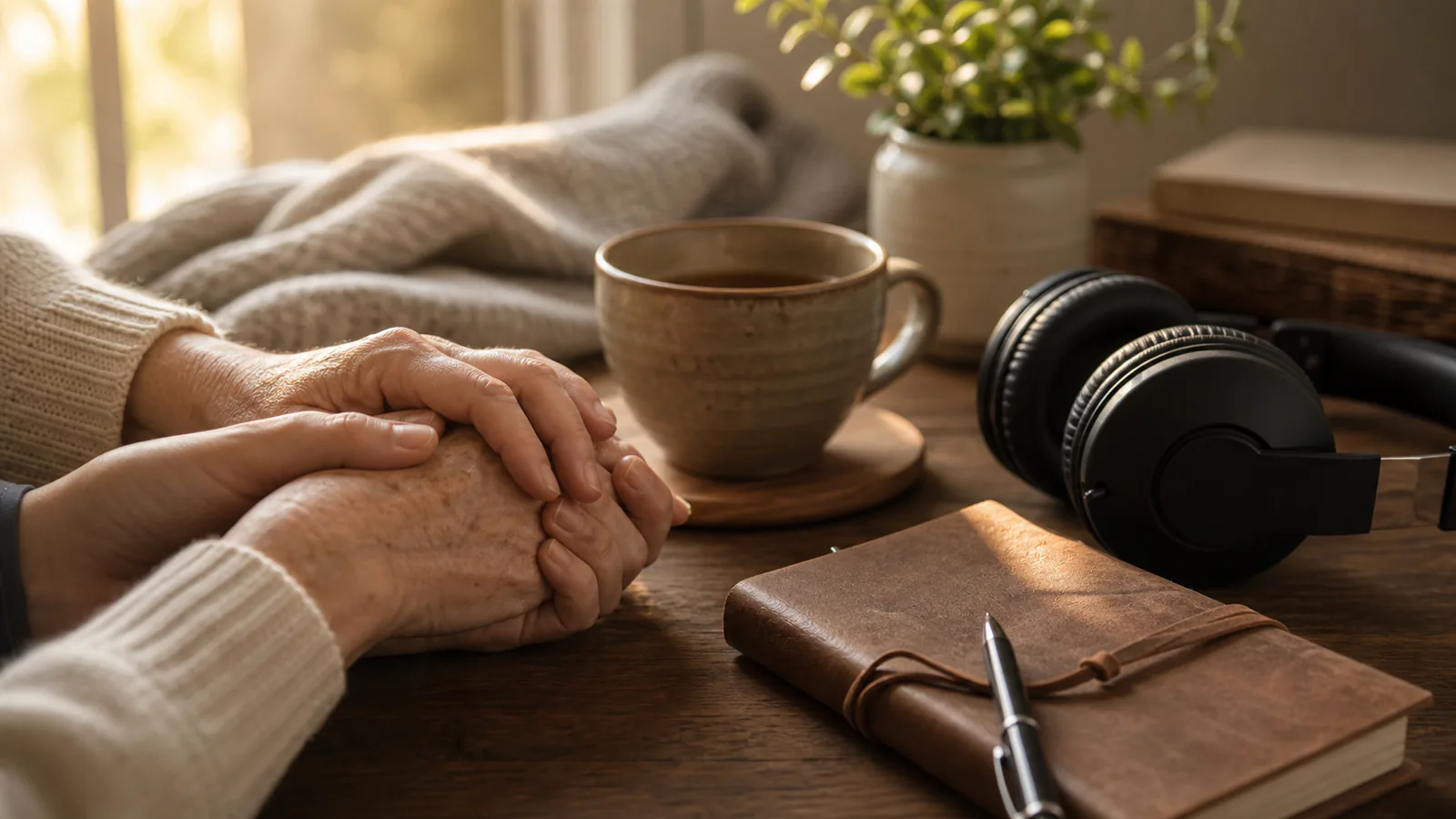
Because caregivers lose their name first. Within a few months of taking it on, they become "his daughter," "the wife," "the one who handles everything" — at appointments, on the phone, in the family group chat. A song that opens with their actual first name, and is about them rather than about the person they care for, reverses that in the first four seconds.
This is the single most common briefing mistake: people send us a beautiful description of the ill parent and almost nothing about the son who has been managing the whole thing. Keep the person being cared for in the song — they belong there — but as someone the caregiver loves, not as the subject. The subject is the one holding it together. A track written purely to say thank you follows the same rule when the recipient is anyone else who quietly carries something.
Which sound and tempo fit best?
Warm and unhurried: acoustic guitar, piano and cello, usually somewhere between 65 and 80 BPM, with a melody simple enough to hum while loading the dishwasher. Anything faster reads as a party, and this is not a party.
- Around 70 BPM, acoustic. The default. Reads as steady rather than sad, which is the tone you want.
- Folk or country. Good for long-tenured caregiving and for people who prefer plain language over metaphor.
- Gospel or soul arrangements. Choose them for the sound — the choir stack, the organ pad, the big last chorus — when the family already listens that way.
- Sertanejo, bolero or MPB. The right call when the household's music has always been in Portuguese or Spanish; the accent matters more than the genre.
- Their own artists. The most reliable route of all. Name the four artists they have played in the kitchen for a decade and the arrangement follows.
Keep the vocal low in the mix and the words clear. This is a track that will be listened to alone, at low volume, in a parked car — clarity beats production.
When is the best time to give it?
Not on a hard day. The best moments are the ones with a natural pause: a birthday, a discharge from hospital, the anniversary of the day the caregiving started, November's caregiver awareness month, or the week after a stretch that everyone knows was brutal. The National Institute on Aging's caregiving material keeps returning to the same point: carers are advised to schedule their own breaks precisely because nobody else schedules one for them, so pick a moment and put it in the calendar.
Give it twice, in this order. First privately — a link sent in the morning, so they can listen alone and react without an audience. Then out loud, with the family present, because half the value of the song is that other relatives finally hear the inventory of what one person has been doing. Keep that second listen small: a phone speaker at the kitchen table, three minutes, nobody asked to make a speech afterwards.
How much does a caregiver song cost?
Between $30 and $200 for most orders, delivered in 24 hours to about a week. Compared with the other gifts people reach for, the difference is not really price — it is whether the gift creates another task for someone who already has too many.
| Gift for a caregiver | Typical cost | Time to arrange | What they end up with |
|---|---|---|---|
| Flowers and a card | $40–$80 | Same day | Something to water, then throw out |
| Spa or massage voucher | $80–$200 | 2 days | A booking they have to find cover for |
| Meal delivery, two weeks | $120–$300 | 1 day | 14 dinners they didn't cook |
| Four hours of respite help | $60–$200 | 1–2 weeks | One afternoon off |
| Custom song, entry tier | $30–$80 | 24–48 hours | A 2–4 minute MP3 |
| Custom song, mid tier | $80–$200 | 2–7 days | Longer track, revisions included |
| Custom song plus lyric video | $100–$250 | 3–7 days | Track plus a clip the family can share |
The voucher is the trap on that list: it costs the most in effort, because using it means arranging cover for the person at home. The song costs them nothing to receive. If more than one person in the family deserves the same treatment — the sibling who does the weekends, the neighbour who has a key — a monthly song membership works out cheaper than ordering them one at a time.
What do you put in the brief?
Write it as if you were explaining this person to a new nurse: who they are, what they do, and what not to bring up. Twenty minutes of honest notes beats an hour of adjectives.
- Their first name and how it is said. Include the nickname the family uses. The vocal should not stumble on the one word that matters most.
- Who they care for, and since when. "My mother, since Dad's stroke in March 2023." A date anchors the whole lyric.
- Three specific tasks from an ordinary day. With times. The 6:15 medication, the Tuesday drive, the Sunday pill organizer.
- One thing nobody sees. The warmed towel, the crossword read out loud, the radio in the parking lot.
- What they gave up. Briefly, and only if they have said it out loud themselves.
- The exact off-limits list. Diagnoses, prognoses, money, the arguments between siblings, the days they lost their patience. Write it in plain words.
- Tone. Steady and grateful is the default. Say clearly if you want it lighter, or if this family jokes rather than gets sentimental.
- Genre, tempo and language. Around 70 BPM for a tribute, 100 to 120 for a celebration, and name two or three artists they actually listen to.
The full framework, including how much detail is too much, is in our guide to writing the brief. One thing to be clear about on our side: the briefing and the review are handled by people, while the recording itself is generated from that brief — which is why a finished 3-minute track can come back the same day you sit down to write the notes.
Frequently asked questions
Should the song mention the person they care for?
Yes, but as a supporting character. Naming the parent, spouse or child makes the story real and gives the lyric something to hold on to. The mistake is letting them take over the song, which happens easily because their situation is more dramatic. Keep the caregiver as the subject of every chorus, and keep clinical detail out entirely — the diagnosis is not yours to put in a lyric.
What if they cry when they hear it?
Most people do, and it is not a failure of the gift. A specific line about a 2 a.m. hallway light tends to land harder than any general thank-you, because it proves someone was paying attention. Send it privately first so the initial listen happens without an audience, then let them decide whether the family hears it at the table. Never play it for the first time in front of a room.
How long does it take to get the song?
Entry-tier orders usually arrive in 24 to 48 hours, mid-tier in two to seven days, and anything with multiple rounds of revision in one to two weeks. The delay is almost never on the production side — it is the brief, which people start three times and abandon because they are trying to be poetic. Write the plain list of tasks and times instead. It takes twenty minutes and it produces better lyrics.
Can several family members share the cost?
Yes, and it is the most common way these get ordered. One person collects the money and, more importantly, owns the brief; a chorus written by committee turns into something generic. Gather raw details from everyone in one thread — the specific tasks each person has witnessed — then let a single person write it up and send it. At $30 to $200 split across four or five relatives, the per-person cost is smaller than the flowers.
What should stay out of the lyrics?
Medical detail, money, prognosis, and any hint of how it ends. Also leave out the days the caregiver snapped, the sibling who never visits, and anything framed as a promise about recovery. The song is a record of what one person does, not a prediction and not a settling of scores. If you are unsure about a line, read it to someone else in the family before it goes into the brief.
Related reading
Nearby situations, different mechanics: music sent to someone who cannot get out when the recipient is the one at home rather than the one caring, songs built for someone living with dementia when memory is the thing being worked with, and care you can replay in a hard season when the difficult stretch is temporary rather than a long-term routine.
They have been keeping someone else's life running for months. Start the brief for their song — write down one ordinary Tuesday, and let the track say what nobody has said out loud yet.
About the Author
HosannaSong Team
The HosannaSong team helps people turn meaningful stories into custom songs. We write about personalized music, songwriting, and the craft of giving a track that lasts.
View ProfileHow to Use Music for Meditation: A Practical Daily Guide
Personalized Music for Dementia Patients: Songs That Reach Back
Related Articles

Music Gift for Homebound Seniors: A Track Made Just for Them
Read Article
Personalized Music for Dementia Patients: Songs That Reach Back
Read Article
Song for Someone Going Through a Hard Time: Care You Replay
Read ArticleTurn this story into a custom song.
Answer a short brief, choose the style, and get a personalized song made to move the person you love. Start while the memories are still fresh.
Create My Song Now